Get the field guide, free
Enter your email address. We send one confirmation mail; click the link in it and the guide is yours right away, in English and Dutch. In English, Dutch, French, German or Spanish. You also join the monthly newsletter: new guides, new free tools and short product notes. One click unsubscribes.
Handled by Extend NV, Antwerp. See the privacy policy. Our email provider counts opens and clicks so we can see which guides are useful; one click unsubscribes.
Printers quote different numbers. This guide gives you a place to start.
Every figure comes from the PrintFilmReady guides and tools, and the ones that depend on your own mesh, ink, paper and press are marked as starting points, with the quick test that turns them into your numbers. It is written for small shops, artists, teachers and anyone who prints with screens and wants to understand why something goes right or wrong.
What you will be able to do afterwards
Pick the right line frequency for your mesh
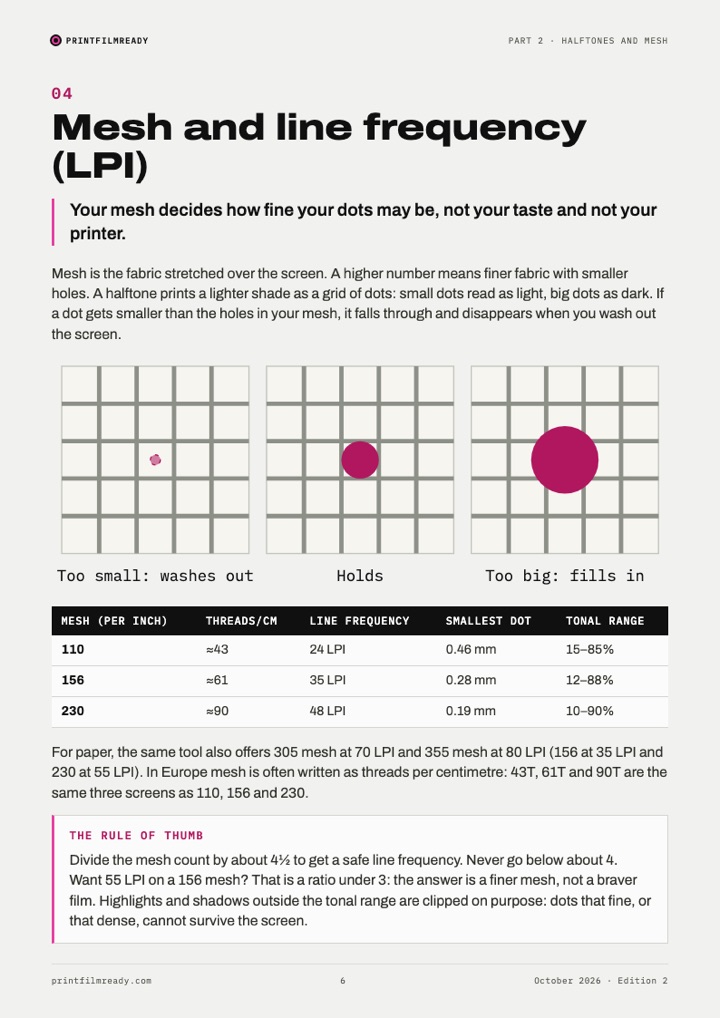
Divide the mesh count by about 4½: 110 mesh holds 24 LPI, 156 holds 35, 230 holds 48. See why 55 LPI on a 156 mesh is a mesh problem, not a film problem.
Stop moiré before it costs you a screen
Why 22.5° works, the four usual causes of moiré, and a fix-it-in-this-order list for when it shows up anyway.
Mix inks you can repeat next week
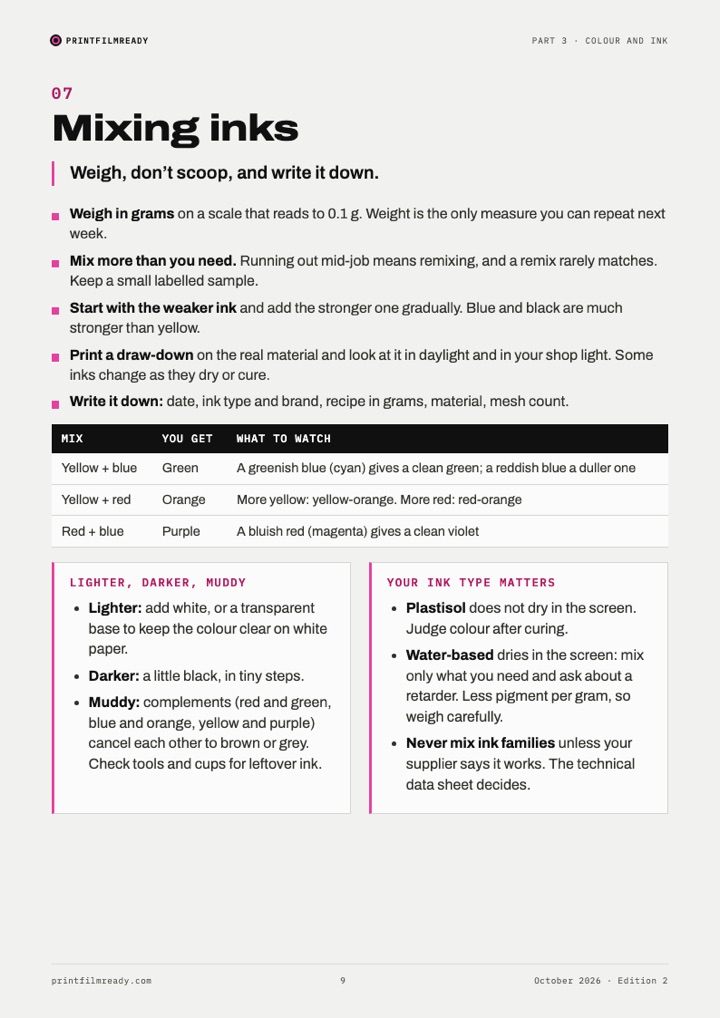
Weigh instead of scooping, write the recipe down, and know what changes between plastisol and water-based ink before you judge a colour.
Print halftones on dark garments
When you need a white underbase, which mesh to burn it on (110–160, or 180–200 under fine detail), why you choke it and why you flash it.
Hide a press that drifts
Overlap starting points from 0.1–0.2 mm on fine paper work to 0.75–1 mm on large formats, and when transparent inks overprint into a third colour.
Expose and register with confidence
A step test instead of guessing, exposure latitude per emulsion, registration crosses, hinge clamps and the order in which to register the layers.
Inside: 17 chapters, 4 checklists and a glossary
One chapter per page, grouped the way a job runs. Every chapter opens with the one sentence to remember and ends where the next job step begins.
Part 1 · Before you print
- 01The big picture
- 02Design for screen printing
- 03Prepare the file
Part 2 · Halftones and mesh
- 04Mesh and line frequency (LPI)
- 05Angles and moiré
Part 3 · Colour and ink
- 06Colour separation and screens
- 07Mixing inks
- 08Transparent inks, overprint and overlap
- 09Dark garments: the white underbase
- 10CMYK process for full colour
- 11Duotone and tritone
Part 4 · Films, screens and press
- 12Textile, paper and lino compared
- 13Making the films
- 14Exposure and emulsion
- 15Registration
Part 5 · Special jobs
- 16Lino and block printing
- 17Posters, repeats, books and zines
- 18The free tools
Part 6 · Reference
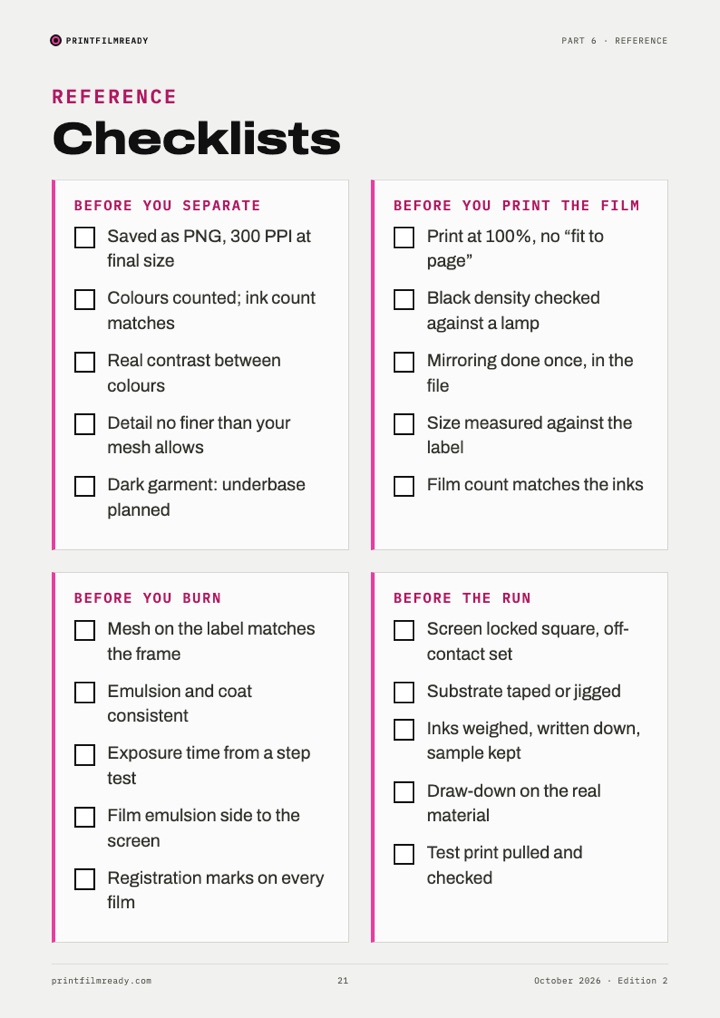
- Checklists: before you separate, print the film, burn and run
- Glossary
- PrintFilmReady: free trial and Pro
Look inside
Real pages, not a mock-up.
A few of the numbers inside
| Question | Starting point in the guide |
|---|---|
| Which LPI on a 156 mesh? | 35 LPI (mesh ÷ about 4½), with the tonal range that survives: 12–88% |
| Thinnest line that prints? | About 0.5 pt (0.18 mm) on fine mesh, about 1 pt (0.35 mm) on a shirt; knocked-out lines need more |
| Angle for one spot colour? | 22.5° with a round dot, on every layer, and never 45° |
| Four-colour angles? | C 20°, M 80°, Y 65°, K 50°, with a 240% ink limit so four layers do not stack too thick |
| Underbase mesh? | 110–160 for a solid white base, 180–200 when fine halftone detail goes on top |
| How much overlap? | 0.1–0.2 mm on fine paper work, 0.2–0.3 mm on an automatic textile press, 0.5 mm on a hand press, 0.75–1 mm on large formats |
Honest about its limits
These are starting points, not laws: your mesh, ink, paper and press move them, so the guide tells you how to test each one. It is not a sales brochure either. The tool is mentioned where it saves you a step, in a box marked as such, and the last page explains the free trial and Pro in plain numbers.
Questions
Is it really free?
Yes. The guide is a free PDF. The one thing we ask is that you confirm your email address, which also puts you on the monthly newsletter. You can unsubscribe in one click and keep the guide.
What happens after I sign up?
You get a confirmation mail within a minute or so. Click the link in it and you land on a page where the guide is ready to download in your language, and in the four others. If nothing arrives, check your spam folder or write to support@printfilmready.com.
Do I need PrintFilmReady to use it?
No. The chapters on mesh, moiré, ink, exposure and registration apply to any film workflow. Where the tool does something for you, it is described in a box marked “In PrintFilmReady”.
Which languages is the guide in?
English, Dutch, French, German and Spanish: the same content and the same pictures in every language. Read this page in your language with the language switch, and the download page offers all five PDFs.
I am already on the newsletter.
Enter your address again. You get the confirmation mail and then the download page, and you are not added twice.
Will I hear when the guide is updated?
Yes. When we add guides, blog posts or tools that change the advice, the guide is revised and the new edition is emailed to everyone who asked for it, in their language. You can unsubscribe from that in one click.
Ready when you are
23 pages, free, in your inbox in a minute.